Arrakis · Dune
Dune map of Arrakis
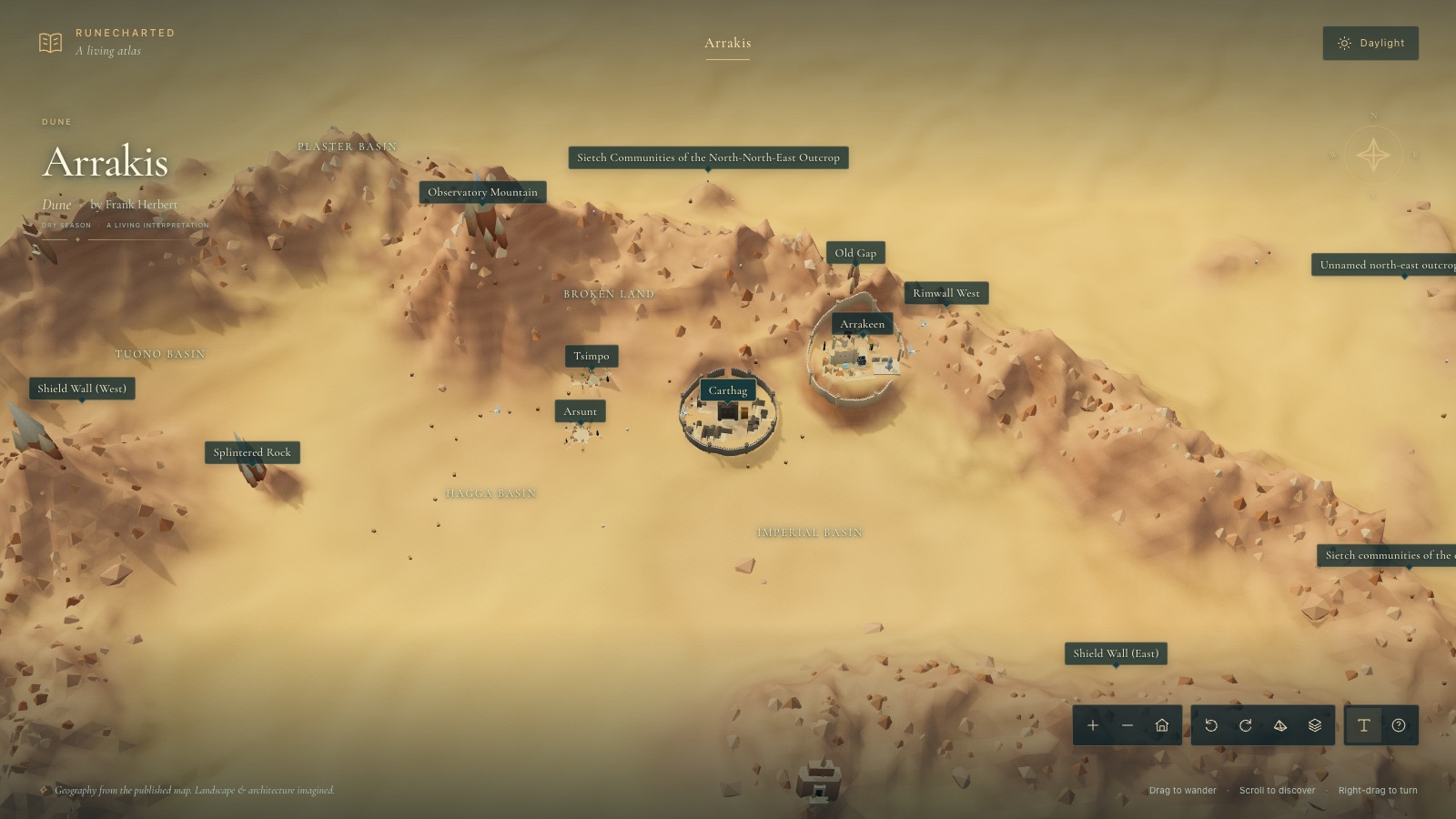
Start with the map of Arrakis printed in Dune, then zoom into an interactive 3D desert: Arrakeen on the Shield Wall, Carthag and the Imperial Basin, Sietch Tabr, the Funeral Plain, the Great Flat and the Habbanya Erg.
In this atlas
What you can explore
The world is Arrakis only, the desert region that Dorothy de Fontaine’s map in Dune draws, and it is spoiler-safe for the first book: nothing from the later novels is shown as present, and there is no globe or off-planet scene (no Caladan, Giedi Prime or Kaitain). The map printed with the book is the template, shown unchanged at the overview, with the Ace deluxe edition’s redraw by Matt Griffin and the Folio Society edition’s map by Sam Weber registered onto it as layers. Zoomed in, the atlas names places the way readers search for them: Arrakeen, Carthag, Sietch Tabr, Tuek’s Sietch, the Shield Wall, the Funeral Plain, the Habbanya Erg, the Great Flat and the Cielago Depression, with the plate’s own printed spellings kept as aliases.
- Open Arrakis
The wider setting
Arrakis map
De Fontaine’s map with its Shield Wall, rims, basins, dune seas, passes and sietch marks traced, walled Arrakeen and Carthag, the rock-face sietches, the poles and the mapped landmarks built at map scale, and the Ace and Folio Society redraws registered over it.
A route through the map
Zoom all the way out to see de Fontaine’s map unchanged. Move closer to reveal the terrain, rims and buildings. The map is north-up, drawn in a polar projection with the pole inside the inner circle. Select a place to fly there; night mode lights Arrakeen and Carthag with warm windows, the sietches with tiny pale-gold lamps and the Polar Sink’s water-works in cyan, under an indigo sky.
Try these starting points:
Questions about this map
Where is Arrakeen on the map of Arrakis?
Arrakeen stands at the north-east end of the Shield Wall, on a rim of bedrock above the Imperial Basin, with Carthag a little west of it across the Broken Land. The printed map arrows its label to a city mark on that rim; the Residency and the spaceport beside it are placed from the text (Book One, paraphrased). Select Arrakeen to fly there.
Where is Sietch Tabr in Dune?
Sietch Tabr is marked at the west end of the Shield Wall, beside Tuono Basin and below the Rock Outcroppings. It is the Fremen sietch of Stilgar’s band and the place where Paul and Jessica find refuge in Book Two; the atlas draws it as a rock face with a dark door and a few lamps rather than a town on the sand.
What is the Shield Wall and what does it protect?
The Shield Wall is the great curved mountain barrier printed twice on the map, once on the west (altitudes up to 4800 m) and once on the east (up to 4500 m). In the book it shelters Arrakeen and the basins behind it from the worst of the desert (Book One, paraphrased). The atlas draws it whole and unbroken.
Where are Carthag and the Imperial Basin?
Carthag is the larger, blunter walled city among the marks of the Imperial Basin ring, west of Arrakeen along the rim and south of the Broken Land. The Imperial Basin is the big basin inside the Shield Wall arc, ringed by the pyon villages the map marks as starbursts, with Hagga Basin on its west side and the Old Gap in the rim above it.
Where is the Funeral Plain, and what lies south of the Great Flat?
The Funeral Plain is lettered across the empty north-west corner of the map, outside the polar circle. The Great Flat is lettered across the western plains below it, and further south the Habbanya Erg fills the south-west quarter. An arrow beside the Great Flat points west, off the map, to the Palmaries of the South; the palmaries themselves are not mapped.
What is the Habbanya Erg and where is Habbanya Ridge?
The Habbanya Erg is the great sand sea in the south-west quarter of the map. Habbanya Ridge is the small dotted ridge outline inside it, with the Cave of Birds at its southern end. The atlas draws the erg as long gold dune ridges and sends the occasional worm wake across it.
Where are Cielago and Tuek’s Sietch?
The Cielago Depression is the dash-dot outlined hollow south of the polar circle, marked at minus 200 m on the map; the map prints Cielago North and Cielago South. Tuek’s Sietch lies on the south-east flank, south of the Minor Erg. Map 1 prints its name as Tuck’s Sietch, the spelling the book and the wiki correct, so both forms find it in the atlas.
Which map of Arrakis is printed in the book, and who drew it?
The map in the first edition (Chilton, 1965) was drawn by Dorothy de Fontaine, and it is the template here. The Ace deluxe edition (2019) carries a redraw by Matt Griffin and the Folio Society edition (2020) a map by Sam Weber; both are registered onto the first map to check spellings, and neither moves it.
Is the Dune map spoiler-free for people still reading the first book?
It is built for the first book only. Nothing from the later novels is mapped or shown as present, the Shield Wall stands whole, and there is no globe or off-planet scene. Place cards cite the book part and chapter where a place appears and can name what happens there; there is no chapter-by-chapter filter.
Geography and artistic interpretation
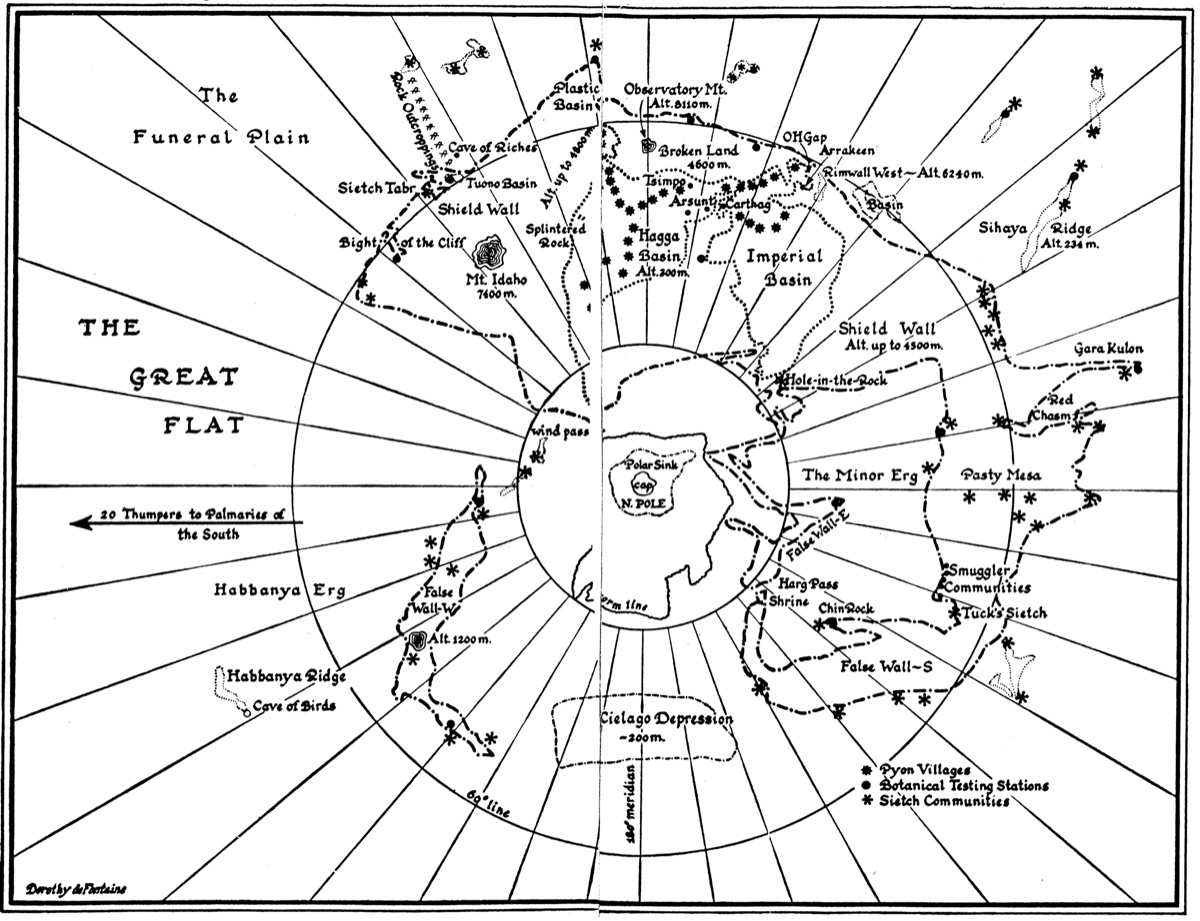
Three maps were used: Dorothy de Fontaine’s map of Arrakis printed with the first edition (the template, shown at overview), the Ace deluxe edition’s Desert Regions of Arrakis redrawn by Matt Griffin and the Folio Society edition’s map by Sam Weber, both registered onto it to check spellings and read every label. Positions follow the printed map; the Arrakeen Residency and the spaceport are placed from the text, and building forms, terrain heights, colours, ornithopters and worm wakes are original interpretations, not official art.
Read this map’s source and interpretation notes. The research notes may discuss later-book geography.
Before you explore: spoilers
Places are shown as the first book leaves them: the Shield Wall stands whole and the plains are empty. Nothing from the later novels is mapped, and place cards paraphrase with a chapter locator and can name what happens at a place; there is no chapter-by-chapter filter.